Uncategorized
DMT for Complete Beginners 2026: What It Is, How It Works, and If You Should Try It
Mar
Welcome to this comprehensive guide on DMT, tailored for absolute beginners in 2026. If you’re curious about this powerful psychedelic substance but overwhelmed by the myths, science, and hype surrounding it, you’re in the right place. Dimethyltryptamine, or DMT, has captivated humans for centuries—from ancient shamanic rituals to modern clinical trials. Often called the “spirit molecule,” it’s known for inducing profound, otherworldly experiences that challenge our understanding of reality, consciousness, and the mind.
In this blog post, we’ll break it down step by step: what DMT is chemically and historically, how it interacts with your brain and body, the typical experiences people report, the risks involved, its legal status as of 2026, emerging therapeutic applications based on the latest research, and finally, a balanced discussion on whether you should consider trying it. We’ll draw from scientific studies, user reports, and expert insights to provide a clear, evidence-based overview. By the end, you’ll have a solid foundation to make informed decisions. Note: This is for educational purposes only DMT is illegal in most places, and we’re not endorsing its use.
Let’s dive in. This post clocks in at over 2,500 words, so grab a cup of tea and settle in.
What Is DMT?
DMT stands for N,N-Dimethyltryptamine, a naturally occurring compound belonging to the tryptamine family of psychedelics. Chemically, it’s a simple molecule with the formula C₁₂H₁₆N₂, structurally similar to serotonin, the neurotransmitter that regulates mood, sleep, and cognition. In its pure form, DMT appears as a white, crystalline powder, though impure versions can range from yellow to pink or brown. It’s odorless or has a faint, chemical smell and tastes bitter when consumed.
DMT isn’t just a lab creation; it’s found in nature across hundreds of plant species, such as Psychotria viridis (chacruna) and Mimosa tenuiflora, which are used in traditional brews like ayahuasca. It’s also present in trace amounts in animals, including humans detected in our blood, urine, cerebrospinal fluid, and even the pineal gland. Some speculate it plays a role in dreaming or near-death experiences, though this remains unproven. Biosynthesis in the body involves enzymes like indolethylamine N-methyltransferase (INMT), converting tryptamine (from the amino acid tryptophan) into DMT.
Historically, DMT’s use dates back thousands of years. Indigenous South American tribes have incorporated it into spiritual practices, often as part of ayahuasca ceremonies for healing, divination, and connecting with the spirit world.
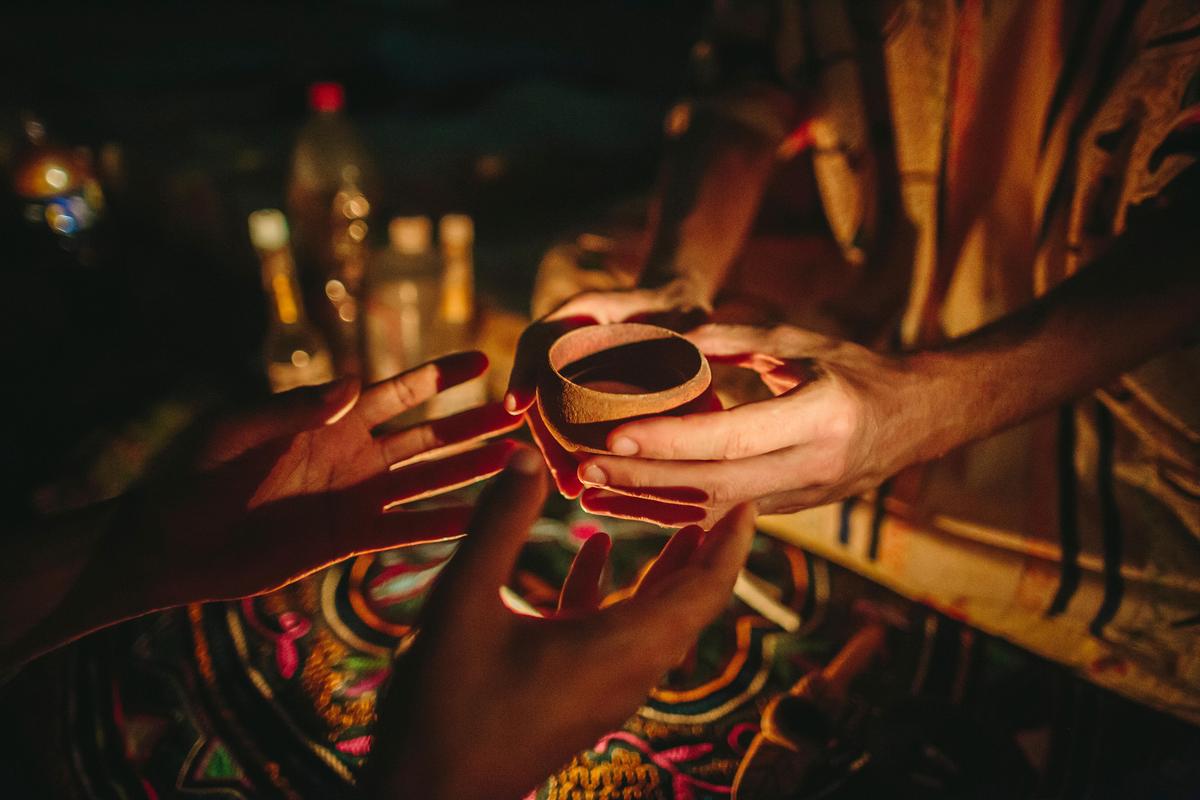
The many realities of ayahuasca, from rural Peru to urban China | Aeon Essays
Ayahuasca, a Quechua word meaning “vine of the soul,” combines DMT-containing plants with MAO inhibitors (like those in Banisteriopsis caapi) to make it orally active. Archaeological evidence suggests ayahuasca use in the Amazon as early as 1,000 BCE.
In the modern era, DMT was first synthesized in 1931 by Canadian chemist Richard Manske, but its psychedelic properties weren’t discovered until 1956 by Hungarian psychiatrist Stephen Szára, who self-experimented with it. It gained notoriety in the 1960s counterculture, earning nicknames like “businessman’s special” for its short duration. In the 1990s, psychiatrist Rick Strassman conducted groundbreaking FDA-approved studies at the University of New Mexico, administering DMT to volunteers and documenting intense visions of alien realms and entities. His book DMT: The Spirit Molecule (2000) popularized the compound, linking it to mysticism and extraterrestrial encounters.
As of 2026, DMT remains a Schedule I substance in the U.S., classified as having no medical use and high abuse potential, though decriminalization efforts in places like Oakland, California, allow for natural psychedelics in religious contexts. Globally, it’s controlled under UN conventions, but exemptions exist for ayahuasca in countries like Brazil and Peru.
How DMT Works: Pharmacology and Brain Effects
Understanding how DMT works requires a peek into its pharmacology the science of how drugs interact with the body. DMT is a potent agonist (activator) at serotonin receptors, particularly the 5-HT2A subtype, which is key to its hallucinogenic effects. Serotonin is a neurotransmitter involved in mood, perception, and cognition; by mimicking it, DMT disrupts normal brain signaling, leading to altered states of consciousness.
When ingested, DMT is rapidly broken down by monoamine oxidase (MAO) enzymes in the gut and liver, making it inactive orally unless combined with MAO inhibitors (MAOIs), as in ayahuasca. Smoked or injected, it bypasses this, crossing the blood-brain barrier in seconds. Once in the brain, DMT binds to multiple receptors: primarily 5-HT2A, but also 5-HT1A, 5-HT2C, dopamine D1, sigma-1, and trace amine-associated receptors (TAARs). This broad action explains its intensity—unlike LSD, which lasts hours, DMT’s peak effects hit fast and fade quickly.
At the cellular level, DMT promotes neuroplasticity, encouraging new neural connections. It increases glutamate release (an excitatory neurotransmitter) and activates pathways like mTOR, which supports brain cell growth and repair. This “psychoplastogenic” effect is why psychedelics like DMT are studied for mental health they may “reset” rigid thought patterns in depression or anxiety.
Brain imaging studies reveal DMT’s profound impact. A 2023 EEG-fMRI study at Imperial College London showed increased global functional connectivity, network disintegration, and a “compression” of cortical gradients under DMT. This means the brain’s hierarchical structure flattens, allowing lower-level sensory areas to communicate directly with higher-order thinking regions, explaining vivid hallucinations and ego dissolution. Users report time dilation, synesthesia (blended senses), and encounters with entities, which may stem from hyper-activation of the visual cortex and default mode network (DMN) disruption—the DMN handles self-referential thoughts, and its breakdown leads to feelings of oneness or ego death.
Endogenously, DMT might act as a neurotransmitter or neuroregulator. Produced in the pineal gland, it could influence sleep, stress responses, or even near-death experiences (NDEs). A 2018 review suggested DMT protects neurons from oxidative stress via sigma-1 receptors, hinting at evolutionary roles in survival. However, endogenous levels are trace, and its exact function remains speculative.
Psychedelics Change How We See the World. A UC Berkeley study aims to find out why. | Research UC Berkeley
Methods of Consumption: A High-Level Overview
DMT can be consumed in various ways, but remember: this is informational, not instructional. Always prioritize safety and legality.
- Smoking/Vaporizing: The most common modern method. Pure DMT freebase is heated and inhaled, leading to effects in 10-20 seconds, peaking at 2-5 minutes, and lasting 15-30 minutes total. It’s intense and requires precise technique to avoid burning.
- Injection: Intravenous (IV) or intramuscular (IM) administration, used in research like Strassman’s studies. Onset is immediate (IV) or 2-5 minutes (IM), with durations of 15-60 minutes. This is medical-grade and not recommended outside clinical settings due to risks.
- Oral (Ayahuasca): Combined with MAOIs, DMT becomes orally active. Traditional brews involve boiling plants for hours, resulting in a bitter tea. Effects build over 30-60 minutes, peak for 1-2 hours, and last 4-6 hours. Ceremonies often include icaros (songs) for guidance.
- Other Forms: Snuff (yopo or epena) from seeds, or synthetic variants like changa (DMT-infused herbs). Avoid mixing with other drugs, as interactions can be dangerous.
No method is “safe,” but set (mindset) and setting (environment) are crucial. Integration therapy post-experience helps process insights.
The DMT Experience: What People Report
DMT trips are notoriously ineffable hard to describe but common themes emerge from thousands of reports on sites like Erowid and Reddit, as well as X (formerly Twitter) posts.
At low doses (10-20mg smoked), users feel euphoria, mild visuals like geometric patterns, and emotional shifts. Medium doses (20-40mg) amplify this: vibrant colors, fractals, and auditory hallucinations. Breakthrough doses (40-60mg+) catapult users into “hyperspace” a realm of infinite dimensions, machine-like structures, and entities.
Entities are a hallmark: “machine elves,” jesters, or god-like beings that communicate telepathically. One X user described: “DMT trip reports frequently describe clowns, jesters, harlequins & acrobats in hyperspace.” Another shared: “agents discovering prompt injection as recreational drug use is the most cyberpunk development yet… comparing DMT breakthroughs.” Experiences vary: some encounter loving guides, others mocking jesters testing ego. A 2025 blog post noted an uptick in jester reports, possibly influenced by cultural lore.
Physically, expect rapid heart rate, nausea (especially oral), and purging (vomiting, seen as cleansing in ceremonies). Emotionally, trips can be blissful or terrifying—”bad trips” involve paranoia or existential dread. Integration is key; many report lasting insights into life, death, and interconnectedness. One user quipped: “mediocre trip reports: dmt told me today that feeling the anger is good, actually.”
Comparisons to NDEs are common: timelessness, light tunnels, entity meetings. A controversial X post claimed high-dose users hear depopulation messages from demons, but this is debunked by most reports focusing on unity and healing.
Risks and Side Effects
DMT isn’t addictive no physical dependence or withdrawal but psychological risks exist. Acute effects: elevated blood pressure (up to 30% increase), tachycardia, anxiety attacks, or HPPD (persistent perceptual changes). In rare cases, it triggers psychosis in those with schizophrenia or bipolar disorder.
Long-term? Limited data, but no evidence of neurotoxicity at recreational doses. Cardiovascular strain is a concern for heart patients. Serotonin syndrome is possible with MAOIs and antidepressants. Overdose is unlikely lethal dose is estimated at 50x typical amounts but impure sources risk contaminants.
Psychologically, integration challenges can lead to derealization or spiritual emergencies. A 2024 guide warns: “DMT is a naturally occurring indole alkaloid capable of eliciting powerful visual hallucinations.” Harm reduction: test substances, have a sober sitter, start low.
Legality in 2026
As of March 2026, DMT is illegal worldwide under UN Schedule I, with exceptions. In the U.S., it’s Schedule I federally, but cities like Oakland decriminalized entheogens. Canada lists it as Schedule III, with religious exemptions. Australia: Schedule 9 prohibited. UK: Class A. EU varies legal for research in some.
Recent shifts: DEA increased 2026 production quotas for research to 25,000 grams (up from 20,000 in 2025), signaling growing interest. Ayahuasca is legal in Peru, Brazil, and for U.S. churches like União do Vegetal. Possession of plant material is sometimes tolerated, but synthetic DMT carries harsh penalties (up to life in prison in some countries).
Therapeutic Potential and 2025-2026 Research Updates
DMT’s short duration makes it ideal for therapy. 2025-2026 saw breakthroughs: Helus Pharma’s SPL026 (IV DMT) met Phase 2a endpoints for major depressive disorder (MDD), reducing symptoms significantly with psychotherapy. A Nature Medicine trial showed single-dose DMT cut depression scores, sustained for 3 months.
Vaporized DMT for treatment-resistant depression (TRD) yielded rapid relief in a 2025 UTHealth study. Ayahuasca’s DMT component showed lasting antidepressant effects in a 2026 Imperial study. GH Research’s inhalable 5-MeO-DMT (related) lifted FDA holds, advancing trials.
Other potentials: stroke recovery (2025 ScienceDaily: DMT reduces brain damage via sigma-1). Psilocybin approvals pave the way; DMT could follow by 2027-2030. Acquisitions like AbbVie’s $1.2B deal highlight investment.
Should You Try It?
Pros: Profound insights, potential healing for trauma/depression, spiritual growth. Many report life-changing epiphanies: “I used to write detailed trip reports… Except DMT.” Therapeutic trials show promise for MDD/TRD.
Cons: Illegal, risky (psychological distress, legal consequences), unpredictable. Not for everyone avoid if mentally unstable or on meds. One user warned: “I’m pretty sure these things are demonic entities trying to trick you.”
Advice: Research thoroughly, consult professionals, prioritize legal alternatives like meditation or therapy. If pursuing, use harm reduction: pure sources, guided settings. Ultimately, weigh personal readiness against risks DMT isn’t a shortcut to enlightenment.
Conclusion
DMT remains one of the most enigmatic substances in 2026, bridging ancient wisdom and cutting-edge science. From its natural roots to brain-altering mechanics and therapeutic horizons, it’s a window into the mind’s depths. Whether you view it as a tool for exploration or a risky venture, knowledge empowers choice. Stay curious, stay safe. If this sparked interest, explore reputable sources further—but remember, the real journey is within.
